
Guildford's Weyside Urban Village budget would rise by £198.7m to £527.6m. Councillors decide on 3 December and 19 January; the forecast loss is kept private.
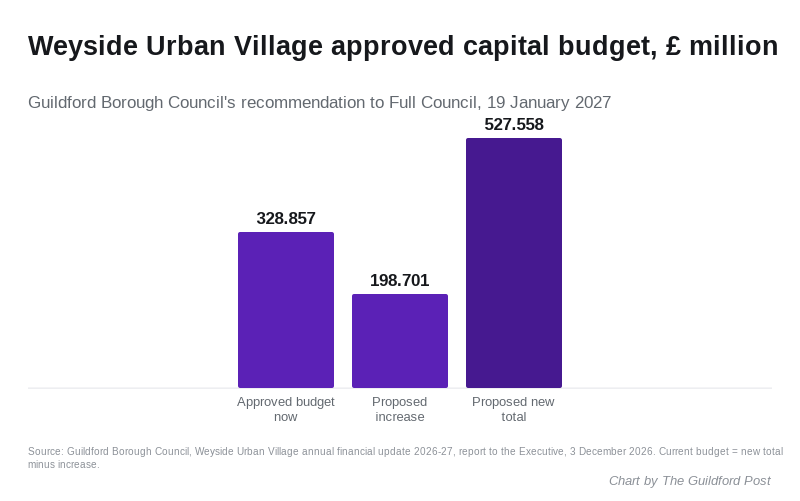
Guildford Borough Council is being asked to raise the budget for Weyside Urban Village by £198.7 million. That would take the total approved capital budget for the 1,500-home scheme at Slyfield to £527.6 million.
The figures are in the council’s annual financial update on the scheme (report to the Executive, PDF). The Executive meets on Thursday 3 December. Full Council has the final say on 19 January 2027.
The exact recommendation is an increase of £198.701 million, “resulting in a total approved capital budget of £527.558 million”. The approved budget today is therefore about £328.9 million.
Why the bill has grown
The report says the money is not new spending that has appeared this year. The rising cost has already been reported in earlier updates and built into the council’s spending plans. The vote “formalises the cumulative growth in the programme forecast since the original budget approval”, the report says.
It blames the wider economy. It names:
- construction costs, with tender price inflation at 3.2% in the third quarter of 2026
- borrowing costs, which raise the price of paying for roads, drains and power before any land is sold
- a weak housing market, with cautious buyers and housebuilders slow to invest
Borrowing is the biggest single change this year. The council now assumes it will pay 3.8% interest to the end of 2026/27, 4.5% in 2027/28 and 5% after that. The appendix calls this “the most significant adverse movement” in the new figures (Appendix 1, PDF).
The loss is still a secret
The council has warned of a deficit on Weyside since January 2023. Each update since has reported a worse one. This year’s report says “a material forecast deficit remains”.
It does not say how big. The figure, the options appraisal, the risk register and legal advice on the Thames Water contract are all in exempt appendices. The report says they are not expected to be made public.
The Independent Assurance Panel, which has overseen the council since 2024, has read them. Its finance lead says the forecast loss “seems to be reasonable” on current assumptions. He also says many of those assumptions are “outside its control and which will change over time”.
Three options, and why stopping costs more
The report sets out three choices:
- Carry on as planned (recommended). Finish the infrastructure, then sell the housing plots to developers.
- Stop the infrastructure but finish the sewage works. The council would still pay for Thames Water’s new treatment works, due in September 2027. The rest of the land would stay unremediated and “unsaleable”.
- Stop everything now. The council signed a contract with Thames Water in 2020 to pay for the new works. The report says there is no way to walk away from it, and trying to would risk “significant compensation claims”.
The panel’s finance lead says stopping “would bring forward the revenue impacts of the scheme”. On the paper’s assumptions, that would mean “higher losses”.
What has been built so far
The report lists the work done since the last update:
- the new council depot, finished in September
- the electricity substation on the former sludge lagoon site, powered up in autumn 2025
- the on-site infrastructure for phase 2 of the scheme
- a start on phase 2 of the internal estate road, including the link to the new depot
- a start on the off-site highway works
- demolition of 30 Woking Road and Mangles House for the off-site road works
- a start on the new nature space at Burpham Court Farm, nearly 50 hectares
Thames Water’s new sewage treatment works is due to finish in autumn 2027, after a 12-month commissioning period. The next phase, clearing the old depot and part of the old sewage works, is due to start in April 2027. We reported the £10.4 million demolition contract for that work in November.
What West Surrey Council will have to decide
Guildford Borough Council is abolished on 1 April 2027. The report lists the decisions it expects to pass to West Surrey Council during 2027/28. They include:
- whether to keep 40% affordable housing across the site, or apply to cut it because of the scheme’s finances
- whether to build the employment sites itself or sell the land
- how to sell the first housing plots, including whether council housing money should buy in
- whether to fund a new county waste transfer site at Weyside, a decision expected in December 2027
All Homes England grant for the scheme has now been spent. The council still has to meet the grant’s delivery milestones, which mainly concern homes being built.
What it means for you
- No direct effect on council tax yet. The panel’s finance lead says that while the scheme is being built, and interest keeps being added to the project’s costs, there will be “no immediate impact on the general fund and thus Council tax levels until the scheme is completed”.
- The risk passes to West Surrey Council. He says the new council “will need to be mindful of the potential future impact of this scheme” when it sets its medium-term budget.
- Affordable homes are on the table. The 40% share is in the planning permission. Any cut would need a new planning application, which residents could comment on.
- You can watch the decision. The Executive meets at 7pm on 3 December (agenda). The Overview and Scrutiny Committee was due to look at the report on 26 November, and its comments go to the Executive.
In September the council’s oversight panel warned that the scheme’s finances were likely to worsen. This report is the update that panel was waiting for.
Sources: Weyside Urban Village annual financial update 2026-27, report to the Executive, 3 December 2026; Appendix 1, financial and economic context; Executive agenda, 3 December 2026.
Have your say