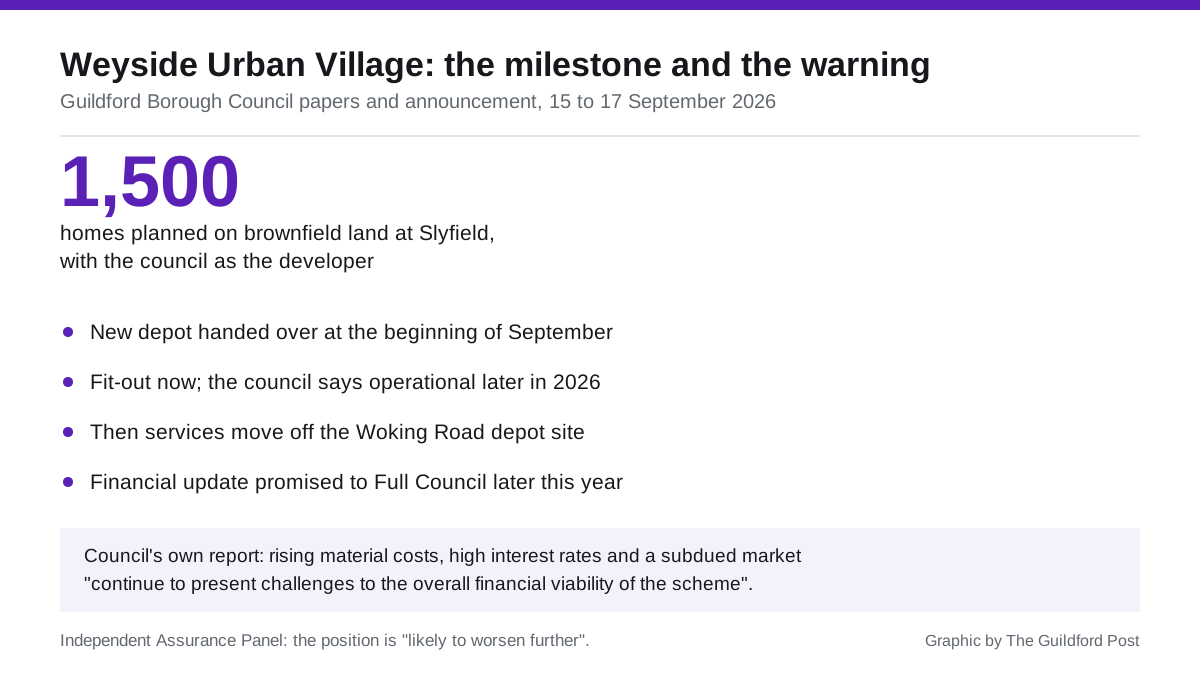

Guildford marked its new Weyside depot on 17 September. Its own panel says the scheme's finances are likely to worsen and could hit West Surrey's budget.
Guildford Borough Council has taken the keys to its new depot at Slyfield, the building that has to be finished before the rest of the Weyside Urban Village can be built. In the same week, the council’s own papers set out why the scheme that pays for it is in trouble.
The council announced the handover on 17 September, with a ceremonial key handover from main contractor McLaren Construction. Its report to Full Council on 15 September said the depot was “scheduled to be handed over to the Council at the beginning of September”, allowing fit-out to start before services move off the existing Woking Road site (Improvement Plan two-year update, paragraph 1.8).
The new building, to be called Weyside Depot, contains:
- a three-storey operational hub with offices, training rooms, meeting spaces and welfare facilities
- a fully equipped vehicle workshop
- a multi-storey car park with electric charging for council vehicles
- specialist storage buildings
Fit-out starts now. The council says the depot should be “fully operational later this year”, at which point services relocate and the next phase of the regeneration can begin.
Cllr Vanessa King, Deputy Leader and Lead Councillor for Economy and Place, said the scheme had “enabled us to transform a former landfill site into this modern new depot”. Cllr Angela Goodwin, Lead Councillor for Environment and Sustainability, called it “a major investment in our services, our staff and our borough”.
The warning in the same set of papers
Two paragraphs later in the same report to Full Council, the tone changes. The council writes that “ongoing geopolitical instability, together with continued macroeconomic uncertainty, is placing additional financial pressure on the Weyside Urban Village programme”.
It then names the three pressures: rising construction material costs, high interest rates and a subdued housing market. These, it says, “continue to present challenges to the overall financial viability of the scheme”.
And it commits to a date of sorts. “A comprehensive update on the programme’s financial position and associated impacts will be presented to Full Council later in the year.”
What the independent panel said
Guildford has been under external oversight since July 2024, when an Independent Assurance Panel was appointed after two critical reviews. The panel’s fourth report went to the same 15 September meeting, and it is more direct than the council.
On Weyside, the panel says the financial position “is unlikely to have improved and is likely to worsen further due to a mixture of factors such as weak demand, cost inflation and site delays all of which are outside the Council’s control” (paragraph 4.2.7).
It also looks past this council’s own lifetime. Guildford Borough Council is abolished on 31 March 2027 and replaced by West Surrey Council. The panel’s conclusion warns that the scheme “could have a significant adverse impact on the financial position of its successor authority’s revenue budget in later years and there should be no loss of focus on mitigating these risks”.
The panel’s recommendations are that Guildford keeps West Surrey informed so the position can be built into that council’s medium-term financial strategy, and that it reviews “all possible mitigation options” for West Surrey to decide on.
This is not a new problem
A report to Full Council in May 2024 first advised councillors of a deficit on the Weyside programme. The mitigation options went to the Overview and Scrutiny Committee for Resources on 2 December 2024, and the minutes of that meeting show what was on the table (item OSR27).
One option was cutting the share of affordable homes across the site. A committee member spoke against it, and others backed keeping delivery at 40% affordable, with one saying that changing the tenure balance “would defeat the objectives of the WUV programme”. The Lead Councillor for Regeneration replied that reducing affordable housing “was not a choice desired by the Council”, but had to be included as an option to mitigate the deficit.
Another option was an income strip. Asked about it, the same lead councillor confirmed there was a risk that index-linked payments to an investor would outstrip any increase in the rent received.
What the scheme is meant to deliver
Weyside Urban Village is the borough’s largest housing site and the council is the developer. On the project’s own website it is described as approximately 1,500 homes on brownfield land at Slyfield, alongside a relocated sewage treatment works, the new council depot, and a local centre with up to 1,800 square metres of retail space including a convenience store.
The council is funding the sewage works relocation because, as councillors were told in 2024, remediating the old works site was cheaper than remediating the landfill on which the new works sits.
What it means for you
- The depot is real and finished, and it is the part with a date. Fit-out now, operational later in 2026, then the Woking Road site is released.
- The number to wait for is the financial update to Full Council “later in the year”. That is the paper that will say what the programme now costs and who carries it. We will report it.
- The risk lands on the next council, not this one. Anything unresolved by 31 March 2027 transfers to West Surrey Council, which sets its own budget and council tax. What that means for bills is not yet published, and we will not guess at it.
- Roadworks around Slyfield are part of this scheme. Clay Lane and the roads around the industrial estate have been repeatedly dug up for Weyside infrastructure. Live closures are tracked on our Guildford roadworks and travel page.
On the rest of the panel’s report, Guildford’s Best Value risk is judged “much lower” than in 2024, and housing remains “the single most significant area of risk for the Council”. The borough’s other planning arguments are set out on our Guildford planning news page.
Sources: Guildford Borough Council, depot completion announcement; Improvement Plan two-year update, report to Full Council, 15 September 2026; Independent Assurance Panel fourth report; Overview and Scrutiny Committee, Resources, 2 December 2024, item OSR27; Weyside Urban Village project website.
Have your say