
1,733 of Guildford's 1,750 working-age claimants would get less help under West Surrey's draft scheme, paying at least 15% of their bill. Consultation to 3 Dec.
Almost every working-age household in Guildford that gets help with its council tax would get less from April 2027, under a draft scheme for the new West Surrey Council.
The council’s own modelling covers the 1,750 Guildford households on Council Tax Reduction today. It finds:
- 1,733 (99.0%) would receive less
- 13 (0.7%) would receive more
- 4 (0.2%) would be broadly unchanged
The draft is out to public consultation until 3 December 2026 (Surrey LGR Hub). The figures come from the consultation’s own questions-and-answers document (West Surrey CTR consultation FAQs). It counts only changes of more than £1 a month.
Why Guildford is hit hardest
Council Tax Reduction cuts the bill of people on low incomes. It is credited to the council tax account, not paid as cash. Each borough sets its own rules for working-age claimants, and the six in West Surrey differ.
Guildford’s scheme can cover 100% of the bill. So can Waverley’s and Woking’s. The draft West Surrey scheme caps support at 85%, so every working-age claimant would get a bill for at least 15%.
That is why the three boroughs on 100% now see almost all their claimants lose out: 99.0% in Guildford and Waverley, and 99.7% in Woking. In Runnymede, Spelthorne and Surrey Heath, which already have lower maximums or different methods, between 16% and 26% of claimants would gain.
Across West Surrey, 10,683 of 12,174 claimant households (87.8%) would receive less. The six current schemes cost about £19.44 million a year. The draft is modelled at about £16.30 million, roughly £3.13 million (16.1%) less.
What the draft scheme would change
The main proposals in the draft are:
- an 85% maximum award, so everyone pays at least 15% of their bill
- support capped at Band D, so homes in Bands E to H pay the whole difference above the Band D charge
- a £6,000 savings limit, above which a household gets nothing; your own home does not count
- a means test with a 20% taper, cutting support by 20p for every £1 of income above the household’s assessed needs
- a flat £10 a week deduction for each other adult living in the home, such as a grown-up son or daughter
- a minimum income floor for self-employed claimants after a 12-month start-up period, treating them as earning 35 hours a week at the minimum wage
- no recalculation for small Universal Credit changes, under £100, to cut repeated new bills
- up to three months of backdating
Across West Surrey, the FAQ says 149 current claimants have savings over £6,000 and would lose their support entirely. Of 2,060 households with another adult living with them, 811 would receive less because of the £10 deduction. It does not break those two figures down by borough.
Pension-age claimants are not affected. Their support follows national rules.
What it could mean in pounds
We have worked out what a Guildford household on the maximum award would be left to pay under the draft. We used this year’s Guildford town-area charges, because the 2027/28 charges have not been set. Parished villages pay a little more.
| Band | Full bill 2026/27 | Left to pay under the draft | Share of the bill |
|---|---|---|---|
| A | £1,667.46 | £250.12 | 15% |
| B | £1,945.36 | £291.80 | 15% |
| C | £2,223.28 | £333.49 | 15% |
| D | £2,501.18 | £375.18 | 15% |
| E | £3,057.00 | £931.00 | 30.5% |
| F | £3,612.82 | £1,486.82 | 41.2% |
| G | £4,168.64 | £2,042.64 | 49.0% |
| H | £5,002.36 | £2,876.36 | 57.5% |
Under Guildford’s current rules, the same household on full support can pay nothing. At Band D, the draft would mean about £7.21 a week. Any income above the household’s assessed needs, or another adult in the home, would add more on top.
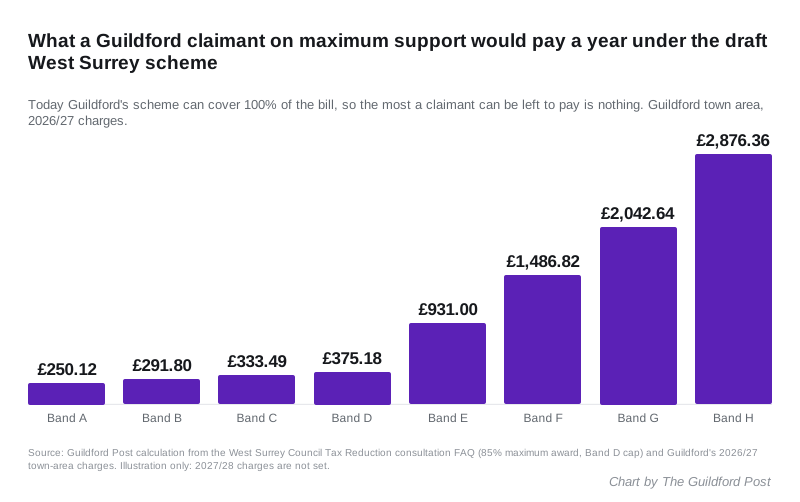
The table is our calculation from the draft’s 85% limit and Band D cap. Charges come from our Guildford council tax bands page. The FAQ’s own example uses a West Surrey average Band D of £2,559.13, which gives £383.87 a year.
What is not decided
The FAQ is clear that nothing is final. Five options were modelled: means-tested schemes with maximums of 100%, 95%, 90% and 85%, and an income-banded design. The 85% version was chosen to go out to consultation.
Two protections are still open:
- Transitional protection, temporary extra help for some existing claimants while the rules change. The FAQ says it “is not intended to reimburse the general reduction”, and who gets it, for how long and at what cost are undecided.
- Exceptional hardship support, which the new council will keep as a separate route. Its details have not been published.
A decision is expected in January 2027, with the scheme starting on 1 April 2027. Existing awards carry on under Guildford’s rules until then.
What it means for you
- If you get Council Tax Reduction now, nothing changes this year. Your award continues under Guildford’s scheme until at least 31 March 2027.
- Respond by 3 December. The online questionnaire asks about each part of the scheme. Paper copies, help over the phone and other formats are available on 01276 707100, the Surrey Heath contact centre acting for West Surrey, or by email to Ctrswestsurrey@surreylgrhub.gov.uk.
- A text or email about it is genuine. The councils are contacting residents through GOV.UK Notify, the government’s messaging service.
- Your answers cannot affect your claim. The FAQ says responses cannot identify you and will not change an award or account.
- If you live in Band E or above and claim support, the Band D cap is the change to look at most closely. At Band E it would leave you paying almost a third of the bill.
Shadow councillor Leslie Rice, West Surrey’s portfolio holder for finance, said the aim “is to ensure the new scheme is fair, sustainable and meets the needs of residents across West Surrey” (Surrey LGR Hub).
The same shadow authority is also deciding where the new council will be based: see our report on the West Surrey headquarters recommendation.
Have your say