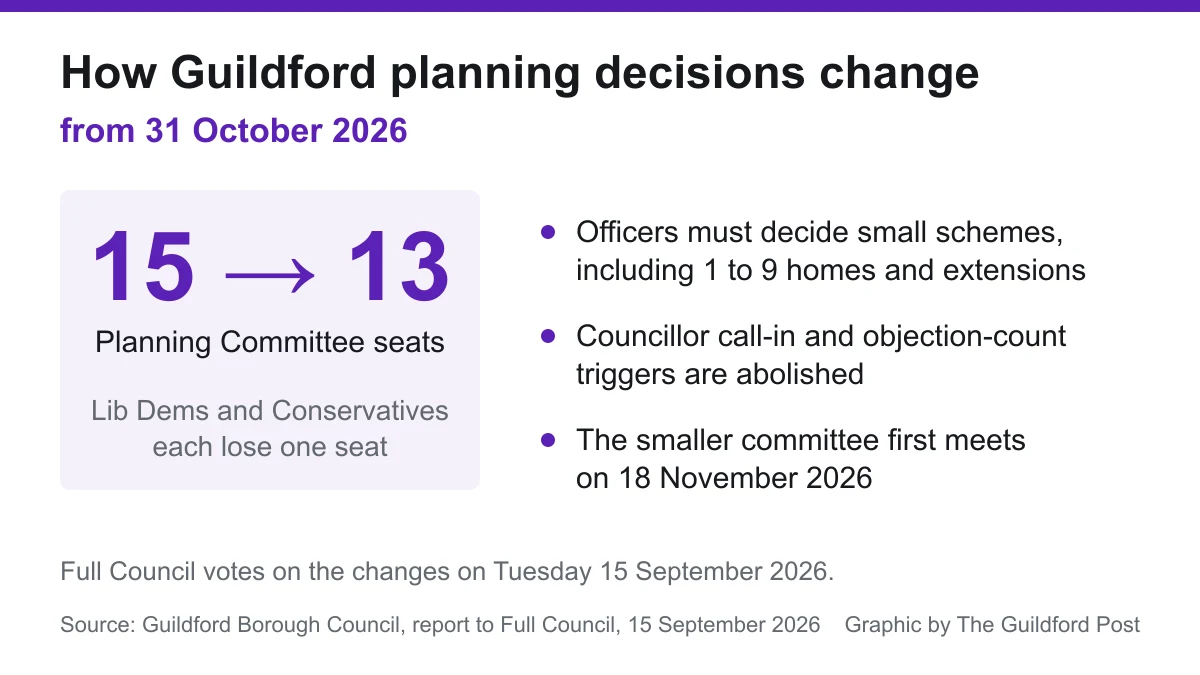

From 31 October councillors lose call-in of small planning applications, and the committee shrinks from 15 to 13. The changes went to Full Council on 15 September.
Guildford’s councillors will decide far fewer planning applications from 31 October, under changes put to Full Council on Tuesday 15 September. The Planning Committee itself shrinks from 15 members to 13, and the familiar routes that pushed an application in front of councillors, a ward councillor calling it in or a pile of objection letters, are abolished.
The council’s decisions sheet from the 15 September meeting had not been published when this page was updated on 16 September. We will report the recorded outcome, including the committee appointments, once it appears on the council’s meetings pages.
The council had no real choice in the substance. The report to the meeting says Guildford must run its planning functions under the Government’s new national scheme of delegation from 31 October, or face judicial review from “anyone aggrieved by a decision made otherwise than in accordance with the national scheme”.
What the national scheme does
The scheme comes from regulations made in July under changes to the Town and Country Planning Act, with statutory guidance issued in June. It sorts applications into two schedules:
- Schedule 1 must be decided by officers. That covers householder extensions, minor commercial schemes, small housing schemes of 1 to 9 homes on sites under half a hectare, condition discharges, lawful development certificates and prior approvals.
- Schedule 2, everything else, is presumed to be decided by officers too. An application only reaches the committee if two people agree it should: a “nominated member”, which Guildford proposes to be the Planning Committee chair, and a “nominated officer”, the Director of Planning. If they disagree, officers decide.
To refer a Schedule 2 application, the pair must apply a “gateway test”: whether it raises issues of economic, social or environmental significance to the local area, or significant planning matters against the development plan.
The report is direct about what disappears. Under the current constitution, an application is called to committee automatically if enough public objection letters arrive, if a ward councillor calls it in, or if the council is the applicant. “This will no longer apply,” it says. It also acknowledges the changes “will reduce the instances of residents attending Planning Committee to make verbal representations”.
A smaller committee, from 18 November
The regulations cap planning committees at 13 members. Guildford’s currently has 15, so the Liberal Democrats and Conservatives each lose one seat. The reconstituted committee would be 7 Liberal Democrats, 2 Conservatives, 2 R4GV, 1 GGG and 1 Labour, matching political balance across the 48-seat council. It first meets in its new form on 18 November.
The new arrangements only run to 31 March 2027. Guildford Borough Council is abolished the next day, and the report notes the national scheme will need to be built into the constitution being prepared for the new West Surrey Council.
What it means for you
- If you object to a neighbour’s extension or a small development near you, from 31 October the decision will be made by a planning officer, however many objections are lodged. Asking your ward councillor to call it in will no longer work.
- Written comments still count. Objections and support on any application go to the case officer and remain part of the decision, so commenting through the planning register matters more, not less.
- Large and controversial schemes can still go to committee, but only if the committee chair and the Director of Planning both agree they should.
Also on the 15 September agenda: the council was asked to grant the Freedom of the Borough to The Ranger Regiment, with a special meeting proposed for Monday 30 November at the Guildhall to confer it. The full agenda is on the council’s meetings pages.
Have your say